Form E section-by-section guide
Form E is easier when you understand what each part is trying to collect. Use this table as the quick map, then work through the detailed walkthroughs below. Those walkthroughs now go through the form question by question, using the official Form E numbering, and for each one explain what it is asking, how to fill it in, and the main pitfall to avoid.
One quick note on numbering. The official Form E is organised into five Parts: Part 1 (general information), Part 2 (all your financial details, including income at questions 2.15 to 2.19), Part 3 (what you and the children need), Part 4 (other information) and Part 5 (the orders you want). To make it easier to follow, this guide splits income and needs into their own steps, but every walkthrough below shows the real Form E question numbers so you can fill the PDF in alongside it.
| Form E section | What it asks for | Documents to gather | Common mistake | How Divvio helps |
|---|---|---|---|---|
| Part 1: General information | Marriage, separation, children, health, employment, accommodation, and dependants. | Marriage details, children's details, separation evidence, address and employment details. | Guessing dates, over-writing personal history, or missing children/dependants with financial relevance. | Prompts the factual answers first and keeps them consistent with later sections. |
| Part 2: Financial details | Property, accounts, investments, debts, businesses, pensions, and other assets. | Valuations, mortgage statements, bank statements, investment statements, pension CETVs, loan records, business accounts. | Using pension fund values instead of CETVs, leaving out small accounts, or forgetting awkward debts. | Breaks the asset inventory into smaller sections and validates totals as you go. |
| Part 3: Income | Employment, self-employment, benefits, investment income, pension income, and other income. | P60, payslips, P11D, tax returns or accounts, benefits letters, dividend or rental evidence. | Only listing salary and missing bonuses, dividends, overtime, benefits, or irregular income. | Separates income types so each source is captured in the right place. |
| Part 4: Needs and budget | Monthly income needs, children's costs, housing needs, and future capital needs. | Bills, rent or mortgage evidence, childcare costs, insurance, regular bank outgoings. | Understating realistic costs or forgetting annual costs that need monthly equivalents. | Turns the budget into structured categories before it goes into Form E. |
| Part 5: Other information | Standard of living, contributions, conduct, recent changes, and other relevant financial context. | Evidence of recent asset sales, gifts, transfers, inheritances, or major changes. | Using the section for general relationship history rather than financially relevant context. | Keeps the prompts focused on financial relevance and disclosure. |
| Part 6: Orders and documents | What orders you seek and which supporting documents are attached. | Final document schedule, valuations, statements, CETVs, income evidence, and any case-specific documents. | Attaching partial statements, leaving the document schedule vague, or guessing at order wording. | Checks the document list and gives an official PDF structure at export. |
Divvio walks you through each of these sections in order and turns your answers into a completed Form E.
Start your Form E for freePart 1: General information
Part 1 is the part most people find easiest, because it is almost entirely factual. You are setting out who you are, the shape of your relationship, any children, where everyone is living now, and a few background facts that help the rest of the form make sense. There is no money to value and no case to argue here. The job is simply to state the facts accurately and consistently.
Even though it looks like a form-filling warm-up, take it seriously. These early answers frame everything that follows, and small inconsistencies — a separation date that does not match what you said elsewhere, a child left off the list, a health issue described as a grievance rather than a financial fact — are exactly the sort of thing the other side or the court will pick up on. Keep your wording plain, neutral and short. State what is true; resist the urge to explain, justify or score points.
A useful test throughout Part 1: would a stranger reading only this page understand the basic facts of your situation without confusion? If a date is genuinely uncertain (separation is the classic example), use the best date you can honestly support, and then use that same date every time it comes up. Remember Form E is sworn disclosure — you sign a statement of truth at the end, and giving false information can be punished as contempt of court — so it is about full and frank disclosure, not legal argument. Remember too that, unless the court orders otherwise, you usually file and exchange the completed form no later than 35 days before the First Appointment, so leave yourself time to get the factual details right.
8What to have to hand
Use this as a simple prep list- Marriage or civil partnership certificate (for the exact marriage date and your legal name)
- Your divorce/dissolution paperwork — the issued application, and the conditional order (decree nisi) and final order (decree absolute) if made
- Your passport or driving licence (to confirm full legal name and date of birth)
- Each child's full name and date of birth (birth certificates if to hand)
- Any CMS calculation, child maintenance court order, or written/family-based agreement
- Paperwork for any other court proceedings between you — case number and court name
- Evidence supporting your separation date if it is disputed (tenancy start date, change-of-address letter, a dated message)
- Details of your current address, the other occupants, and your tenancy or ownership terms
Question by question
Your full name
1 / 16What it asks
The form asks for your own full legal name as the person completing this Form E.
How to complete it
Use your full legal name exactly as it appears on official documents — your marriage or civil partnership certificate, passport or driving licence — including any middle names. Do not use a nickname, shortened name or a name you no longer use legally. If you have changed your name since the marriage (for example reverted to a maiden name or changed it by deed poll), use your current legal name and you can note the former name if it helps identify you on other paperwork.
Sarah Jane Thompson (not "Sarah T" or "Sally").
Make sure the name here matches the name used on the divorce/dissolution application and any court order, so the court can link the documents to the right person.
Your date of birth
2 / 16What it asks
Your own date of birth.
How to complete it
Enter your full date of birth in day/month/year order. Double-check it against your passport or birth certificate — a transposed digit is easy to miss and undermines confidence in the rest of your disclosure. Your age is genuinely relevant to a financial remedy outcome (it affects earning years left, pension timescales and retirement), so accuracy here is not just box-ticking.
14/03/1981
Date of the marriage or civil partnership
3 / 16What it asks
The date your marriage or civil partnership legally took place.
How to complete it
Use the exact date shown on your marriage or civil partnership certificate, not the date of any engagement, a religious ceremony that was not legally registered, or the date you started living together. Copy it straight from the certificate so it is exact. The length of the marriage is one of the factors a court weighs, so this date matters more than it first appears.
Marriage date: 02/06/2009 (taken from the certificate).
If you lived together for a long period immediately before marrying, that pre-marital cohabitation can be relevant to the overall case — but this box is only for the legal date; deal with cohabitation context elsewhere rather than altering this date.
Your occupation
4 / 16What it asks
Your current job or occupation.
How to complete it
State your actual current occupation or job title plainly. If you are employed, give the role (for example "Registered nurse" or "Secondary school teacher"). If you are self-employed, say so and give the trade. If you are not currently working, describe your position honestly — for example "Not currently employed", "Full-time carer for the children", "Retired" or "Receiving Employment and Support Allowance". Keep it to the present; your full employment and income detail comes later in Part 2.
Self-employed plumber (sole trader).
Do not inflate or downplay your role to influence the picture — earning capacity is assessed properly later, and an exaggerated or dismissive job title here just looks like spin.
Date of separation
5 / 16What it asks
The date you and your spouse or civil partner separated. There is a "not applicable" option if you have not separated, or are still living together.
How to complete it
Pick the date that best marks when the relationship ended as a couple, and choose the best date you can honestly support — for many people that is the day one of you moved out, or the day you clearly agreed the marriage was over. If you are still living under the same roof, or have not yet separated, tick "not applicable" rather than inventing a date. Whatever date you use, use it consistently everywhere it appears.
Date of separation: 11/09/2024 (the day I moved into rented accommodation). If still cohabiting: tick "not applicable".
Do not guess or pick a date that flatters your case. If the date is genuinely disputed or hard to pin down, note the best date you can support and the reason — and be ready to back it up (a tenancy start date, a message, a change of address), because a separation date that shifts around looks unreliable.
Dates of the divorce/dissolution proceedings
6 / 16What it asks
The date of the petition or application for divorce, dissolution, nullity or (judicial) separation, plus — where they apply — the date of the decree nisi/conditional order and the date of the decree absolute/final order.
How to complete it
Take these dates straight from your court paperwork rather than memory. The application (formerly petition) date is on the issued application; the conditional order (formerly decree nisi) and final order (formerly decree absolute) dates are on those orders if they have been made yet. Leave a date blank only if that stage has not happened — most people completing Form E are part-way through, so it is normal not to have a final order date yet. Note that since the 2022 reforms the modern terms are "conditional order" and "final order", but Form E still uses the older "decree nisi/absolute" wording, and they mean the same thing.
Application issued: 20/01/2025. Conditional order: 05/05/2025. Final order: not yet made.
Do not apply for the final order purely to tidy up this box — finalising the divorce before the financial order is sealed can affect rights such as pension and survivor's benefits, so the financial side is usually settled first.
Date of any subsequent marriage or civil partnership
7 / 16What it asks
Whether you have remarried or entered a new civil partnership since the relevant separation, and if so the date.
How to complete it
Only relevant if you have already legally remarried or formed a new civil partnership. If so, give the date from that certificate. If you have not, leave it blank or mark it not applicable. Remarriage is a significant fact because it can affect your own claims: if you remarry or form a new civil partnership before you have applied for a financial order, you generally lose the right to bring one for yourself (the so-called "remarriage trap"), and remarriage ends any spousal maintenance payable to you — so if this applies to you, get advice before finalising the divorce.
Not applicable — I have not remarried or formed a new civil partnership.
This is about a legally registered new marriage or civil partnership, not simply having a new partner — living with someone is captured separately at 1.8 and 1.9.
Are you living with a new partner now?
8 / 16What it asks
Whether you are currently living with another person as a couple — a straightforward Yes or No.
How to complete it
Answer honestly Yes or No about whether you are currently cohabiting with a new partner. Cohabitation is relevant because a partner's contribution to household costs affects the realistic picture of your needs and expenses, so it is a fair and expected question. You do not need to write a relationship history — a clear Yes or No is what is asked. If Yes, the financial reality of that household will be picked up properly in the income and expenses sections later.
Yes — I have lived with my partner since October 2025.
Do not under-disclose a settled live-in relationship to keep your stated needs looking higher; if it later emerges, it damages the credibility of your whole disclosure.
Do you intend to live with a new partner within 12 months?
9 / 16What it asks
Whether you intend to live with another person within the next 12 months — Yes or No.
How to complete it
Answer based on your genuine current intention. If you have firm plans to move in with a partner within the next year, answer Yes; if you have no such plans, answer No. This is about realistic, foreseeable change to your household, because it affects your future housing and needs. You are not committing yourself to anything by answering — you are disclosing your honest position as it stands today.
No — I have no plans to live with anyone within the next 12 months.
Answer for what you actually intend, not what is most convenient for your case; an answer that is quickly contradicted by events looks evasive.
Children of the family
10 / 16What it asks
Details of any children of the family — each child's full name, date of birth, and with whom each child lives.
How to complete it
List every child of the family, giving each child's full name, date of birth, and who they currently live with. "Children of the family" is broader than just your biological children together — it can include children you have both treated as part of the family, such as a partner's children or step-children, so include them if that applies. For living arrangements, describe the reality plainly (for example "lives with mother", "shared care, alternating weeks", or "lives with father during term time").
Emily Rose Carter, 12/04/2014, lives with mother. Daniel James Carter, 08/11/2016, shared care, week about.
Do not leave out a child who is over 18 but still dependent, or a step-child treated as a child of the family — and keep the living arrangements neutral and factual rather than using this box to argue about contact.
State of health (you and the children)
11 / 16What it asks
Your state of health and that of the children — but only where it is relevant to the financial issues.
How to complete it
Only complete this where a health condition actually bears on money: where it affects earning capacity, creates extra care needs, changes housing requirements, or adds to day-to-day costs. Frame it as a practical financial fact, not a personal narrative — say what the condition is in a sentence and then what it means financially. If health has no real bearing on the finances, it is fine to state that there are no relevant health issues.
I have rheumatoid arthritis, which limits me to part-time work and means I cannot return to my previous full-time role. Our son has Type 1 diabetes, requiring ongoing equipment costs of roughly £40 per month not covered by the NHS.
Resist turning this into a list of grievances or every minor ailment — disclose what is financially relevant and stop there; over-sharing irrelevant medical detail weakens the credibility of the parts that matter.
Children's education and training arrangements
12 / 16What it asks
Present and future arrangements for the education and training of the children.
How to complete it
Set out where the children are educated now and any clear future plans — for example which school or nursery, whether it is state or fee-paying, and any planned transitions such as starting secondary school or going to university. Flag anything with a cost attached, especially private school fees, tutoring, or higher-education support, because these feed directly into the financial picture. Keep it factual: what the arrangement is, and where money is involved.
Both children attend the local state primary school. Emily moves to the local state secondary in September 2026. No private school fees. We expect to support Daniel through a university course from 2034.
If you pay or plan to pay school or university fees, do not omit them here — they are a significant recurring cost that needs to be visible and consistent with your expenses in Part 2.
Child maintenance arrangements
13 / 16What it asks
Details of any Child Maintenance Service or former Child Support Agency calculation, court order, or written agreement for the children.
How to complete it
State whether child support is being paid and how it is arranged: a CMS calculation, a court order, or a private written/family-based agreement. Give the key figures — the amount, how often it is paid, and who pays whom — and note the reference or date if you have one. If there is no arrangement in place at all, say so clearly rather than leaving it blank.
CMS calculation in force: I pay £540 per month for both children, calculated 03/2025. (Or: "Family-based agreement — their father pays £400 per month by standing order; no court order.")
Be consistent — the maintenance figure you give here should match what appears in your income or expenses later; a mismatch between this box and Part 2 is a common and avoidable red flag.
Any application to vary child maintenance
14 / 16What it asks
If a CMS calculation, court order or written agreement is in force, whether there is any application to vary it.
How to complete it
This follows on from 1.13. If a maintenance arrangement is in place and either of you has applied to change it — for example a CMS variation, a mandatory reconsideration, or a court application to vary an order — give brief details and the date. If no variation has been applied for, say so. If 1.13 was not applicable because there is no arrangement at all, this will usually be not applicable too.
No application to vary has been made. (Or: "I applied to the CMS for a variation on 12/04/2025 on the grounds of reduced income; outcome awaited.")
Do not confuse a vague intention to challenge the amount with an actual application — only disclose a variation that has genuinely been made.
Other court proceedings between you
15 / 16What it asks
Details of any other current or past court proceedings between you and your spouse or civil partner — case number, court, and type of proceedings (up to three sets).
How to complete it
List any other legal proceedings between the two of you, separate from the divorce/dissolution itself — for example a child arrangements (contact/residence) application, a non-molestation or occupation order, or any earlier financial proceedings. For each, give the case number, the court, and what type of proceedings it was. Stick to proceedings between you and your spouse or civil partner; unrelated matters involving other people do not belong here.
Children Act 1989 child arrangements application, Family Court at Leeds, case no. LS25P00123, ongoing.
If there have been protective orders such as a non-molestation order, disclose the existence factually here, but if there are any safety concerns or coercive control, get targeted advice before completing and exchanging the form.
Your present residence
16 / 16What it asks
Details of where you currently live — the address, who else lives there, and the terms on which you occupy it (owner, joint owner, tenant, living with family or friends, and so on).
How to complete it
Give your current full address, then list the other occupants (for example the children, a new partner, a relative, a lodger), and then state the legal basis on which you live there. Be specific about the terms: sole owner, joint owner, sole or joint tenant, living rent-free with family, and so on, because this links directly to the property and housing picture in the rest of the form. If you are the one who has moved out, describe your new arrangement honestly even if it is temporary.
Address: 42 Elm Road, Leeds, LS1 2AB. Occupants: me and our two children. Terms: joint owner with my spouse, subject to a mortgage with Halifax. (Or: "Living temporarily with my parents, rent-free, since separation.")
The occupation terms here must line up with how you describe the same property in the assets section of Part 2 — if you call yourself a joint owner here, that property and its equity must appear consistently later.
Common mistakes to avoid
- Guessing or massaging the date of separation instead of using the best date you can honestly support, then using a different date elsewhere on the form.
- Leaving children off question 1.10 — particularly dependent adult children or step-children treated as children of the family.
- Writing health (1.11) as a personal grievance or a list of every ailment, instead of explaining the specific financial impact on earning capacity, care, housing or costs.
- Giving a child maintenance figure at 1.13 that does not match the same figure in the income/expenses sections of Part 2.
- Describing your residence and occupation terms at 1.16 in a way that does not line up with the assets you disclose later — for example calling yourself a joint owner here but not listing that property's equity in Part 2.
Divvio tip
Divvio tip: fill Part 1 with your certificates and court paperwork physically in front of you and copy dates and names straight across, rather than from memory. These factual boxes set the reference points the whole form is checked against, so getting them exactly right here saves you correcting inconsistencies — and losing credibility — further in.
Part 1 walkthrough, field by field
A calm, field-by-field guide to the General Information section, in the order most people actually fill it in.
Read the Part 1 walkthrough →Date of separation on Form E
How to choose the right date, what to do if you still live together, and how to prove it if your ex disagrees.
Read the date-of-separation guide →Can you complete Form E without a solicitor?
A calmer decision guide on when DIY is realistic and when to get targeted legal advice.
Read the article →Part 2: Financial details
Part 2 is the heart of Form E. It is a structured inventory of everything you own and everything you owe, with the value of each item and the evidence behind it. It is not the place to argue what you should keep or how things should be split — that comes much later. Here the job is full and frank disclosure: if an asset or a debt exists and is yours, in whole or in part, it goes on the form.
The section is built around running totals. Each block of questions produces a sub-total (A, B, C1 to C6, D1, D2, E, F and G), and at 2.20 those totals are added up and the debts taken off to give your net assets. That means accuracy and consistency matter. A figure you write at 2.3 has to be the same figure that feeds into Total C and then into 2.20. Work from documents, not memory, and the totals will look after themselves.
A calm way to approach this is to treat it as box-ticking against your document pile rather than a test. Sole-name accounts still count. Small balances still count. Old, frozen or tiny pensions still count. Awkward debts to family still count. Disclosing something and explaining it is always safer than leaving it out and having to explain later why it was missing. Remember the timing too: your completed, signed Form E is normally filed at court and exchanged with the other person no later than 35 days before the First Appointment, unless the order in your case says otherwise, so give yourself time to request the slow documents. And because you sign a statement of truth at the end, a deliberately false or incomplete Form E can be a contempt of court — another reason to disclose in full.
10What to have to hand
Use this as a simple prep list- Estate agent valuations or appraisals for every property (ideally two or three each)
- Up-to-date mortgage statements and a current redemption figure for each mortgage
- Land Registry title information showing the title number and ownership basis
- 12 months of statements for every bank, building society and National Savings account, including joint and overdrawn ones
- Investment, ISA, fund and share statements, plus premium bond and National Savings records
- Current surrender-value letters for any life insurance or endowment policies
- Loan, credit card, overdraft and hire-purchase or car-finance statements
- Pension Cash Equivalent (CETV) statements for every scheme, each showing the calculation date, plus your National Insurance number
- The last two years of business accounts and any director's loan records, if you own or run a business
- Records of cryptocurrency, share options, trust interests or other assets for section 2.14
Question by question
The family home
1 / 15What it asks
Full details of the matrimonial or civil partnership home: its address, Land Registry title number, the mortgage company and type of mortgage, how it is owned, its current value, the mortgage owing, any early-repayment penalty, sale costs and the resulting equity, ending in the value of your interest (Total A).
How to complete it
Work left to right and let the form do the arithmetic: current market value, minus the outstanding mortgage, minus any early-repayment charge, minus costs of sale (estate agent and legal fees — around 2 to 3 percent is a common working figure), gives the net equity. Then enter your share of that equity as the value of your interest. For the value, an estate agent's written appraisal (ideally two or three) is usually enough at this stage; for the mortgage figure use a current redemption statement, not last year's balance. State the ownership basis exactly: sole name, joint tenants, or tenants in common.
Value £420,000 − mortgage £230,000 − early-repayment charge £0 − sale costs £8,500 = equity £181,500. Held as joint tenants, so your interest = £90,750.
Do not skip the ownership basis. Joint tenants and tenants in common are treated differently, and 'joint tenants in common' is not a thing — pick the one that matches your title.
Other property and land
2 / 15What it asks
The same details as 2.1 for every other property or land you have any interest in: buy-to-let, a second home, an overseas property, bare land, a timeshare, or business premises you own personally. Produces Total B.
How to complete it
Repeat the 2.1 method for each property, using a continuation sheet if you run out of space. Include property held jointly with anyone (not just your spouse), property abroad, and a share in a property you co-own with a relative. For overseas property, give the value in the local currency and the sterling equivalent, and note the exchange rate and date you used.
Buy-to-let flat, value £180,000 − mortgage £120,000 − sale costs £4,000 = equity £56,000; owned solely, so your interest = £56,000.
Overseas and inherited property are exactly the kind of thing people wrongly assume is 'off the table'. Disclose it. If valuation or foreign law is genuinely complex, disclose it here and get targeted advice rather than guessing.
Bank and savings accounts
3 / 15What it asks
Every bank, building society and National Savings account: the institution and branch, account type, account number, any other account holders, the balance and the value of your interest. Produces C1.
How to complete it
List all of them, even if there are more than the boxes provided — use a continuation sheet rather than leaving any out. Include current accounts, savings accounts, cash ISAs, joint accounts, and accounts that are overdrawn or hold only a few pounds. Use the balance from your most recent statement and keep that statement in your document bundle. For a joint account, the balance is the full balance and your interest is your share (often half).
Barclays, High Street branch, current account, a/c 12345678, joint with spouse, balance £2,400, your interest £1,200.
Sole-name accounts and small or dormant accounts are the most commonly forgotten. An overdrawn account still belongs here as an asset line with a nil or negative interest — the overdraft debt itself is then picked up at 2.9.
Investments
4 / 15What it asks
Stocks, shares, unit trusts, investment (stocks and shares) ISAs, PEPs, bonds, OEICs, National Savings certificates, premium bonds and government stock: the name and type, the size of the holding, its value, any other holders and the value of your interest. Produces C2.
How to complete it
Take the values from your most recent investment or platform statements and note the date of the valuation, because investments move. Give the type and the size of the holding (for example the number of shares or units) as well as the current value. ISAs that hold stocks and shares go here, not at 2.3. Include premium bonds at their face value.
Vanguard FTSE Global All Cap, stocks & shares ISA, 1,540 units, value £18,900 at 14/05/2026, sole holder, your interest £18,900.
Don't leave out small or long-forgotten holdings, employee share-scheme shares you already own, or premium bonds. Share options that you cannot yet exercise belong at 2.14, not here.
Life insurance and endowments
5 / 15What it asks
Life insurance and endowment policies that have a surrender or cash-in value: the company, policy type and number, any assignment, other owners, the maturity date, the current surrender value, the amount of life cover and who is insured, and the surrender value of your interest. Produces C3.
How to complete it
Only include policies with a surrender value. Ask each provider for a current surrender value in writing and use that figure, not the sum assured or the maturity value. Note whether the policy is assigned (for example to a lender as security for a mortgage), because that affects who benefits from it.
Aviva with-profits endowment, policy 998877, matures 06/2030, life cover £60,000 on you, current surrender value £14,200, sole owner, your interest £14,200.
Term life assurance with no surrender value (a policy that only pays out on death) does not belong here, as it has no cash value — though you can mention it at 2.14 or in Part 5 if it is relevant. Do not confuse the sum assured with the surrender value.
Money owed to you
6 / 15What it asks
Money that other people owe you: a personal loan you have made, a director's loan the company owes you, or a tax rebate due. Asks who owes it, the balance outstanding and the value of your interest. Produces C4.
How to complete it
Include anything genuinely owed back to you, even informally, and say briefly who the debtor is. If repayment is doubtful, still disclose it and note that recovery is uncertain rather than omitting it. A director's loan account in your favour belongs here (and ties in with your business interest at 2.11).
Loan of £5,000 made to my brother in 2024, £3,000 still outstanding, your interest £3,000 (repayment by instalments, no written agreement).
People forget tax rebates due and money the family business owes them. If the debt is disputed or unlikely to be repaid, disclose it and explain, rather than treating 'I'll probably never see it' as a reason to leave it off.
Cash held
7 / 15What it asks
Any single cash sum of more than £500 held anywhere, including at home and abroad: where it is held, the amount, the currency and the value of your interest. Produces C5.
How to complete it
This is physical cash and cash-like holdings not already captured as a bank balance — a safe at home, cash in a deposit box, or foreign notes. Convert foreign currency to sterling and note the rate and date. You only need to list individual sums over £500, but be honest about meaningful cash.
£1,500 cash held in a home safe; plus €800 (≈ £680) held abroad. Total cash interest £2,180.
The £500 threshold is per holding of cash, not a licence to ignore cash overall. Undisclosed cash is a classic disclosure failure that damages credibility for the whole form.
Personal belongings over £500
8 / 15What it asks
Individual personal belongings each worth more than £500 — cars, jewellery, watches, art, antiques, collections — with a brief description and the value of your interest. Produces C6, and Total C is C1 to C6 added together.
How to complete it
List items individually, not as a lump. Use a sensible second-hand or resale value, not the price you paid or the insurance replacement value. For a car, use the trade or private-sale value (a valuation website helps) less any finance owing on it; the finance itself then appears at 2.9.
2019 VW Golf, resale value about £9,000; a watch worth about £1,200; an engagement ring worth about £900. Your interest £11,100.
This is not ordinary household furniture, kitchenware or clothing — you do not inventory the contents of the house. Only items individually worth over £500 belong here. Equally, do not deflate genuinely valuable items to nominal figures.
Liabilities and debts
9 / 15What it asks
All your debts apart from the mortgages already shown above: credit cards, personal loans, overdrafts, hire purchase and car finance, money owed to family, and tax owed. Asks for details, any other account holders, the total liability and the value of your share. Produces D1.
How to complete it
Work from current statements and use the balance owing, not the credit limit. Show the full balance and then your share — for a joint debt, that is usually half. Include the overdraft on any account you listed at 2.3, finance on a car you listed at 2.8, and money genuinely owed to a relative.
Halifax credit card, balance £3,400, sole, your share £3,400; car finance (HP) £6,200, sole, your share £6,200; informal loan from parents £4,000, your share £4,000.
Informal family loans, tax owed (for example a self-assessment bill), and old debts are routinely missed. Don't pad the list with debts that don't exist either — both understating and inflating debts undermine disclosure.
Capital Gains Tax
10 / 15What it asks
Any Capital Gains Tax that would become payable if you sold or transferred the assets you have just disclosed — typically a second property or a shareholding. Asks for the asset and the estimated CGT liability. Produces D2, and Total D is D1 plus D2.
How to complete it
Only complete this where a disposal would actually trigger CGT. Your main home is normally exempt under private residence relief, so it usually produces nothing here; a buy-to-let, a second home or a holding of shares might. Give a sensible estimate and say it is an estimate; if the figures are significant or uncertain, note that an accountant should confirm the number.
Buy-to-let flat at 2.2: estimated CGT on sale approximately £9,500 (estimate only, to be confirmed by an accountant).
Don't invent a CGT figure for your main home to reduce the equity — that is wrong and will be challenged. Equally, don't ignore a real CGT exposure on an investment property, because it genuinely reduces the net value.
Business interests
11 / 15What it asks
Any business interest you hold: the name and nature of the business, your role (sole trader, partner or shareholder), the extent of your interest, when the next accounts are available, any money the business owes you, the current value of your interest with the basis of that figure, estimated CGT on disposal, and the net value after CGT. Produces Total E.
How to complete it
Disclose the existence of the business fully and attach the last two years of accounts. State your shareholding or partnership share precisely. For the value, give your honest view and say clearly how you reached it — but do not pluck a figure out of the air for a business that needs proper valuation. The right approach is often to disclose and propose that a single jointly instructed expert values it.
Smith Joinery Ltd, building trade, 50% shareholder; next accounts due 09/2026; director's loan owed to me £8,000; value of my interest: to be assessed by a jointly instructed accountant (no agreed figure).
Guessing a disputed valuation is the big risk here. If your business is anything more than a simple sole trade, disclose it on the form and get targeted advice on valuation rather than committing to a number you cannot support.
Directorships
12 / 15What it asks
Any directorships you currently hold, or have held in the previous 12 months.
How to complete it
List the company name and your role for each. This is simply a factual disclosure of office held; it does not by itself put a value on anything, but it signals connections to companies that may matter. Include dormant companies and directorships you resigned within the last year.
Director of Smith Joinery Ltd (current); director of Riverside Lettings Ltd (resigned 11/2025).
Don't overlook a small or dormant company you are listed as a director of at Companies House — it is easily checked, and omitting it looks worse than it is.
Pensions and PPF compensation
13 / 15What it asks
Every pension arrangement and any PPF compensation: the provider's name and address, your National Insurance number, the arrangement or reference number, the type of scheme, the Cash Equivalent (CE/CETV) value and the date it was calculated, and whether it is already in payment or drawdown. Produces Total F.
How to complete it
Request a Cash Equivalent (CE or CETV) in writing from each provider and use that figure with the date it was calculated — this is the single most important point in Part 2. State the scheme type clearly: occupational or personal, and whether it is final salary (defined benefit) or money purchase (defined contribution). Include the additional state pension where it applies, every old or frozen workplace pension, and any pension already in payment.
Aviva personal pension, ref PP-44521, money purchase, CETV £62,400 as at 02/05/2026, not yet in payment; plus NHS Pension Scheme, defined benefit, CETV £210,000 as at 28/04/2026.
Never use the fund value from an annual statement. For defined-benefit and final-salary schemes the statement figure can be wildly different from the CETV, so using it can misstate this part by tens of thousands of pounds. CETVs are slow to obtain, so request them first.
Other assets
14 / 15What it asks
Any asset not already listed elsewhere — cryptocurrency, unexercised share options, intellectual property, an interest under a trust, a reversionary interest, money expected from a future court award, or valuable digital assets. Produces Total G.
How to complete it
This is the catch-all, and it is meant to catch real value, not be left blank by default. Disclose crypto holdings with the platform, amount and current sterling value; unexercised share options with the scheme and vesting terms; and any interest under a trust, even a discretionary one where you are only a potential beneficiary. Where you cannot put a firm figure on something (a trust interest, a future inheritance prospect), disclose its existence and explain it rather than omitting it.
0.4 BTC held on Coinbase, current value ≈ £18,000; unexercised EMI share options over 2,000 shares vesting 2027 (no current realisable value); potential beneficiary of the Jones Family Discretionary Trust (no fixed entitlement).
Crypto, share options and trust interests are frequently and wrongly assumed not to count. An interest under a trust must be disclosed even if it is not a fixed sum — describe it and let the value be assessed.
Capital summary
15 / 15What it asks
A summary of your net capital: Total A plus Total B plus Total C plus Total E plus Total F plus Total G, less Total D, to give your net assets.
How to complete it
This is pure arithmetic, but it is where errors show up. Add the property interests (A and B), the contents of section C, your business interest (E), your pensions (F) and other assets (G), then subtract your liabilities and CGT (Total D). Cross-check every figure against the section it came from before you sign — each total here must reconcile exactly with the section above.
A £90,750 + B £56,000 + C £33,180 + E £0 (to be valued) + F £272,400 + G £18,000 = £470,330, less Total D £27,300 = net assets £443,030.
The single most common slip is a figure here not matching the section it is drawn from — for example a pension total that doesn't equal the CETVs at 2.13. If they don't reconcile, the whole form looks unreliable, so check the sums add up before you sign the statement of truth.
Common mistakes to avoid
- Using a pension's annual fund value instead of the Cash Equivalent (CETV) — the biggest single error in Part 2, and worst for final-salary schemes where the two figures differ enormously.
- Leaving out sole-name accounts, tiny or dormant accounts, old frozen pensions, premium bonds, or cash held at home.
- Forgetting awkward debts such as informal family loans, tax owed, or car finance — or, conversely, listing debts that do not really exist.
- Putting a firm figure on a business or disputed asset that actually needs a proper joint valuation, instead of disclosing it and proposing an expert.
- Totals that don't reconcile with the sections above — for example a Total F at 2.20 that doesn't match the CETVs listed at 2.13.
Divvio tip
Fill Part 2 in with your document pile open beside you and complete it in two passes: first list every item from the statements without worrying about the totals, then go back and let each block produce its sub-total and feed those into 2.20. Requesting the slow documents — pension CETVs and mortgage redemption figures especially — on day one is what keeps you inside the 35-days-before-the-First-Appointment timetable.
Enter your accounts, property, debts and pensions once — Divvio organises them into Form E.
Start your Form E for freePart 2 financial details guide
Work through the full asset and liability inventory before you move to income and needs.
Read the Part 2 guide →Bank statements for Form E
Which accounts to include, how many months to provide, and what to do about missing statements.
Read the bank statements guide →Liabilities and debts on Form E
Loans, credit cards, tax debts, family loans, and disputed debts.
Read the debts guide →How to value your property for Form E
When estate agent appraisals are enough, and when you may need better evidence.
Read the property guide →Form E pensions section
How to disclose pensions, request CETVs, and explain missing pension valuations.
Read the pensions section guide →Understanding CETV for divorce
What a CETV is, why it matters, and why an annual statement may be wrong.
Read the CETV guide →Part 3: Income
Part 3 is where you set out every source of income you expect to receive over the next 12 months, source by source. The form deliberately splits income into separate boxes — employment, self-employment, investments, state benefits, and anything else — and each box produces its own running total: H, I, J, K and L. At the very end, 2.21 adds those five totals together to give your total estimated net income for the year ahead. The point of the boxes is to make sure nothing gets quietly folded into a single salary figure and forgotten.
Two ideas run through the whole of this part. The first is that this is a forward-looking estimate: the form is not asking what you earned last year for its own sake, it is asking what you realistically expect to receive in the next 12 months. Last year's figures (your P60, your accounts) are the evidence you build that estimate from, not the answer itself. The second is disclosure first, legal argument second — give a fair, complete picture of what actually comes in, including the awkward extras like bonuses, overtime, dividends and perks, rather than the tidiest version of your income.
Most of this part is net income — that is, after tax and National Insurance — because that reflects what you actually have to live on. Where the form asks for a gross figure as well (as it does for employment and self-employment), provide both. If your income is irregular, has recently changed, or is hard to pin down, the safest approach is to give your best honest estimate and then explain in plain words how you arrived at it. An explained estimate is far more useful than a precise-looking number with no working behind it. Remember that your completed Form E is normally filed and exchanged with your former partner no later than 35 days before the First Appointment, unless the court orders otherwise, so the figures here are the ones the other side and the court will rely on.
9What to have to hand
Use this as a simple prep list- Your most recent P60 (one for each employed job)
- Your last three months' payslips
- Your P11D, if you receive any benefits in kind such as a company car or private medical cover
- Your latest finalised business accounts and tax calculation, if you are self-employed or a partner
- Dividend vouchers and savings interest certificates
- Letting agent or rental statements showing rent received
- Award letters or screenshots for any state benefits, including Child Benefit and State Pension
- Pension payment statements if a pension is already being paid to you
- Any maintenance or PPF compensation payment records
Question by question
Income from employment
1 / 6What it asks
Full details of every employed job you hold, with last year's gross and net figures from your P60 and your average net pay over the last three months, ending in your estimated net income from employment for the next 12 months. This produces Total H.
How to complete it
Work straight from your documents rather than memory: take the gross and net figures for the last financial year from your P60, and the average net monthly pay from your last three payslips. Give the employer's name and address, your job title and a short description, your hours per week, how long you have worked there, and the basis of your income (for example salary, hourly, plus commission). Explain any other entries that appear on your payslips, then disclose the extras separately — bonuses or occasional payments, and any benefits in kind such as a company car, private medical cover or a fuel card — and finish with your honest estimate of net income for the next 12 months. If the last three months are not typical (you were on parental leave, sick, between roles, or had an unusual bonus month), say so and explain what a normal month looks like. Attach your P60, your last three payslips, and your P11D if you have one.
For example: "Average net pay over the last 3 months was £2,640 per month (£7,920 total), but March included a £1,500 annual bonus. A typical month is approximately £2,140 net. Estimated net income for the next 12 months: £25,680, plus a bonus of around £1,500 if paid on the same basis as last year."
Do not stop at basic salary. Overtime, commission, shift allowances, bonuses and benefits in kind all belong here — leaving them out is one of the most common ways a Form E is later challenged for understating income.
Income from self-employment or partnership
2 / 6What it asks
Details of any business you run as a sole trader or partner, built from your most recent completed accounts, ending in your estimated net income from self-employment for the next 12 months. This produces Total I.
How to complete it
Start with your last finalised accounts: give the business name, the date to which those accounts were completed, your share of the gross business profit, the income tax and National Insurance payable on it, and the resulting net figure for that year. Add any benefits in kind the business provides you, and state the amount of any regular drawings you take (the money you actually draw out to live on). Then give your estimate of net income for the next 12 months, and crucially, if that estimate is different from the last accounts — because trade is up, down, or you have changed how the business operates — explain why. Drawings and taxable profit are not the same number, so make clear which is which.
For example: "Accounts to 5 April 2025 showed my share of gross profit at £42,000, income tax and NI of £9,600, net profit £32,400. My regular drawings are £2,000 per month. A major client ended in January 2026, so I estimate net income of around £24,000 for the next 12 months."
If the business is substantial, disputed, or its accounts are complicated, disclose the figures and the accounts but consider targeted advice before signing — self-employment income is a common area for professional scrutiny.
Income from investments — dividends, interest, rental income
3 / 6What it asks
Income you receive from assets you own — dividends from shares, interest from savings, and rent from property you let — stating whether it is paid gross or net, with the amount for the last financial year and an estimate for the next 12 months. This produces Total J.
How to complete it
For each source, describe the nature of the income and the asset it comes from (for example "rental income from 14 Mill Lane" or "dividends from my shareholding in X Ltd"), state whether it is paid gross or net of tax, give the amount received in the last financial year, and your estimate for the next 12 months. Use dividend vouchers, interest certificates, and your letting agent's statements as your evidence. For rental income, give the rent received, not the profit after the mortgage — the form is asking about the income itself.
For example: "Rental income from 14 Mill Lane, received gross: £9,600 in the last financial year (£800 per month). Estimated next 12 months: £9,600. Interest on Nationwide savings, paid gross: £210 last year, estimated £180 next 12 months."
Small amounts of savings interest and modest dividends still count and are easily forgotten — check every account and shareholding rather than assuming a figure is too small to matter.
Income from state benefits
4 / 6What it asks
Any state benefits you receive, including the state pension and child benefit, with the name of the benefit, the amount, how often it is paid, and your estimate for the next 12 months. This produces Total K.
How to complete it
List each benefit by its proper name (Universal Credit, Child Benefit, State Pension, PIP, and so on), the amount, and the frequency of payment — weekly, four-weekly or monthly — then give the estimated total for the next 12 months. Take the figures from your award letters or your online benefits account so the amounts and frequency are exact. Watch the frequency conversion: a benefit paid every four weeks is paid 13 times a year, not 12.
For example: "Child Benefit: £25.60 per week, paid four-weekly (£102.40 each payment). Estimated next 12 months: £1,331. Universal Credit: £612 per month. Estimated next 12 months: £7,344."
Getting the payment frequency wrong throws out the 12-month estimate — a four-weekly benefit multiplied by 12 instead of 13 understates the total, so convert carefully.
Any other income
5 / 6What it asks
Any income not already captured in the boxes above — for example a pension already in payment, PPF (Pension Protection Fund) compensation in payment, or spousal or child maintenance you receive — stating whether it is gross or net, the amount last year, and your estimate for the next 12 months. This produces Total L.
How to complete it
Use this box for income that does not fit employment, self-employment, investments or state benefits. Common entries are a private or occupational pension already being paid to you, Pension Protection Fund compensation in payment, and maintenance you receive from your former partner or for the children. For each, give the nature of the income, whether it is gross or net, the amount received last year, and your estimate for the next 12 months.
For example: "Occupational pension from Teachers' Pension Scheme, paid net: £840 per month (£10,080 last year). Estimated next 12 months: £10,080. Child maintenance received: £300 per month, estimated £3,600 next 12 months."
A pension already in payment is income and belongs here at 2.19 — do not confuse it with the pension's transfer value (the CETV) that goes in the pensions part of the assets section; the two are recorded in completely different places.
Summary of income for next 12 months
6 / 6What it asks
A summary box that adds your five income totals together: H + I + J + K + L, giving your total estimated net income for the next 12 months.
How to complete it
This is an arithmetic summary, not a new question — carry each total down from its box and add them up. The value of the summary is as a final check: read the combined figure back and ask whether it genuinely reflects what comes into your household over a year. If a source you know about is missing, the total will look too low, which is your cue to go back and find which box it belongs in.
For example: "Total H (employment) £25,680 + Total I (self-employment) £0 + Total J (investments) £9,780 + Total K (benefits) £1,331 + Total L (other) £10,080 = £46,871 estimated net income for the next 12 months."
Make sure each total is included once and only once — income that has been recorded in the right box but accidentally left out of the summation, or double-counted across two boxes, is a frequent and avoidable error.
Common mistakes to avoid
- Only entering basic salary at 2.15 and leaving out bonuses, overtime, commission, and benefits in kind, which all have to be disclosed separately.
- Confusing self-employment drawings with taxable profit at 2.16, or copying last year's accounts forward without explaining a change you already know about.
- Treating small savings interest, modest dividends, or rental income as too minor to mention — every source belongs in its box at 2.17.
- Recording a pension already in payment as a capital asset rather than as income at 2.19, or recording the same income in two different boxes.
- Mishandling the 12-month estimate: multiplying a four-weekly benefit by 12 instead of 13, or using last year's figure when you already know this year will be different.
Divvio tip
Divvio tip: build each income box from a document, not from memory — the P60 for last year's employment figures, the last three payslips for your current monthly net, the accounts for self-employment, and award letters for benefits. Then, before you finalise 2.21, read the combined total back as a yearly household figure and ask "does this look like what actually comes in?" That single sense-check catches most missing or double-counted sources.
Part 4: Budget and income needs
Part 3 of Form E is where you set out what you, and any children living with you, actually need to live on going forward. Everything up to this point has been about disclosing what you have; this part looks forward, asking you to build a realistic budget of your regular outgoings (3.1) and your one-off, lump-sum needs such as rehousing (3.2). For most people this is the hardest part of the form to fill in honestly.
The instinct many people have is to make their figures look as low as possible to seem reasonable, or as high as possible to win. Resist both. The court is looking for a true, considered picture of your needs, not a negotiating position. Artificially low numbers can come back to bite you, because the figures here help shape how much income and capital you may need from any settlement. Calm, evidenced realism is what works. This is practical guidance, not legal advice; if your finances are unusually complex, take advice tailored to your situation.
A few mechanics to know before you start. You complete two separate budgets within 3.1: one for yourself and one for the children living with you. For every line you give a current cost and an estimated future cost (your best estimate of the cost after the financial reorganisation, for example once you are rehoused). You choose whether to state figures weekly, monthly or annually, but you must say which and be consistent. The form gives you space to explain why your needs will change, and it produces sub-totals for you and for the children and an overall total. Take the time to do it properly: this is the budget that, alongside the other party's, helps the court assess whether a proposed settlement actually meets everyone's needs.
7What to have to hand
Use this as a simple prep list- 6 to 12 months of bank, current-account and credit-card statements (the most reliable record of what you actually spend)
- Your list of direct debits and standing orders
- Recent utility, council tax, broadband and insurance bills — including annual renewal documents
- Childcare, school and children's activity costs (invoices, nursery fees, club fees)
- An estate agent or property-portal estimate of local rental or purchase prices for rehousing
- A mortgage broker indication or lender illustration for deposit and borrowing costs (if buying)
- Quotes or listings to cost one-off items: a replacement car, furniture and white goods, or any work needed on a property
Question by question
Your income needs (regular outgoings budget)
1 / 2What it asks
A budget of your regular living costs — set out separately for yourself and for any children living with you — showing the current cost and your estimated future cost for each line, with sub-totals for you and for the children and an overall total.
How to complete it
Work from evidence, not memory: pull 6 to 12 months of bank statements, direct debits and card statements and let them tell you what you actually spend, rather than guessing round numbers. Pick one period (weekly, monthly or annually), state which at the top, and convert every figure into it consistently so nothing is double-counted or missed. Split your spending from the children's spending — your share of rent or mortgage, food and utilities goes under you, while their clothing, school costs, activities and childcare go under them. For the 'future' column, give a genuine estimate of life after the split (for example renting your own place, running the home alone, or paying for childcare you did not need before) and use the explanation space to say briefly why each major change is happening.
Sample monthly budget lines (stated monthly): Rent/mortgage — current £0 (living in family home) / future £1,250 (one-bed rental nearby) Council tax — current £165 / future £140 (25% single person discount applies) Gas & electricity — current £190 / future £130 Food & household — current £520 / future £320 Car (fuel, tax, insurance, MOT, servicing — annual £1,800 ÷ 12) — current £150 / future £150 Children — clothing/shoes — current £80 / future £80 Children — after-school club & holiday childcare — current £0 / future £420
Forgetting annual and irregular bills is the single biggest cause of an unrealistically low budget — convert car costs, insurance renewals, dentist, Christmas, birthdays and holidays into your chosen period so they are captured, not dropped.
Your capital needs (one-off lump-sum needs)
2 / 2What it asks
Your one-off, capital (lump-sum) needs rather than monthly costs — listed for yourself and for the children — with the item, the cost, sub-totals for you and for the children, and an overall total.
How to complete it
Think of this as everything you would need a lump sum to pay for, not a recurring monthly bill. The big one for most people is rehousing: a mortgage deposit plus the costs of buying or moving (legal fees, survey, mortgage arrangement fee, any stamp duty, removals) or a tenancy deposit and first month's rent if renting. Then add the cost of furnishing and equipping a new home, a reliable car if you genuinely need one, and any debts you would need to clear. Cost each item from a real source — an estate agent or mortgage broker for deposit and buying costs, online listings for a car, a quote for any work — and keep a note of where each figure came from so you can back it up if asked.
Sample capital needs (you): Deposit for rehousing (10% of £220,000) — £22,000 Buying & moving costs (legal, survey, mortgage fee, removals) — £4,500 Furnishing/equipping new home (white goods, beds, sofa) — £6,000 Replacement car — £7,500 Clearing personal loan to free up income — £3,200 Sub-total (you): £43,200
Don't pad this with wish-list items or leave it blank because it feels awkward — unsupported figures undermine your credibility, but genuinely omitting a real rehousing or furnishing need can leave you short in any settlement, so cost each item honestly and be ready to evidence it.
Common mistakes to avoid
- Leaving out annual and irregular costs — car servicing and MOT, insurance renewals, dentist, Christmas, birthdays and holidays — which makes the whole budget look artificially low.
- Mixing periods (some lines weekly, some monthly) without converting them, so the totals are wrong; pick one period, state it, and convert everything into it.
- Deliberately understating needs to appear reasonable, or inflating them to win — both damage your credibility, and the court is assessing genuine need, not a negotiating stance.
- Filling in only the 'current' column and leaving 'future' blank, when the future figure (life after rehousing, running the home alone, new childcare) is the one that really matters.
- Putting recurring monthly costs into 3.2 (or one-off lump sums into 3.1) — 3.1 is your ongoing budget, 3.2 is for capital, one-off needs like a deposit, a car or clearing a debt.
Divvio tip
Divvio tip: build your 3.1 budget straight from your last few months of bank statements rather than from memory — go through the transactions line by line and you will both capture the irregular bills people always forget and have the evidence ready if the other side or the court questions a figure. Remember the completed Form E is usually filed and exchanged no later than 35 days before the First Appointment (unless the court orders otherwise), so give yourself time to do this properly rather than rushing it at the end.
Build your monthly budget inside Divvio and carry the figures into your Form E.
Start your Form E for freeForm E budget and income needs guide
How to build realistic monthly outgoings, children costs, future housing needs, and annual costs.
Read the budget guide →Build your Section 3.1 budget
Use the budget calculator to sense-check categories before you finalise your monthly outgoings.
Use the budget calculator →Part 5: Other information
You have spent the first three parts of Form E setting out the facts and figures: what you own, what you owe, what you earn, and what you need. Part 4 is different. This is the narrative section, where you give the court the context behind those numbers. It is short, but it matters: it is where a judge starts to understand how your finances reached their current position and where they might be heading.
The golden rule for this whole part is to stay financially relevant. Every box here connects, directly or indirectly, to the factors the court must weigh under section 25 of the Matrimonial Causes Act 1973 (the checklist the court uses to decide what is fair). It is tempting to use these boxes to tell the story of why the marriage ended, who hurt whom, and who was the better partner. Resist that. The court is not deciding who was right; it is deciding how to divide the money and meet each person's needs fairly. Keep your answers factual, brief, and tied to money or needs. Remember that Form E is about full and frank disclosure first, and legal argument second.
A few of these boxes catch people out. Question 4.4 (conduct) sounds like an invitation to vent, but the legal bar is extremely high and the box is best left blank in most ordinary cases. Question 4.2 (standard of living) sounds vague but is genuinely useful to the court. And 4.1 and 4.6 link back to the figures in Parts 1 and 2, so what you write here must be consistent with what you put there. Take these boxes seriously but keep them proportionate — a sentence or two is often plenty. Your completed Form E is signed with a statement of truth and is normally filed and exchanged no later than 35 days before the First Appointment (unless the court orders otherwise), so make sure everything here is accurate before you sign.
8What to have to hand
Use this as a simple prep list- Your completed Parts 1 and 2, so your answers to 4.1 and 4.6 stay consistent with the figures you have already disclosed
- Redundancy, bonus, or settlement paperwork for any significant income change in the last 12 months
- Mortgage offer or rate documents showing when a fixed-rate deal ends and the likely new payment
- Any documents about an expected event in the next year — a business sale agreement, a job offer, or correspondence showing you are a beneficiary of an estate being administered
- A rough note of the standard-of-living markers: property value, cars, typical holidays, schooling, general spending level
- Any medical evidence or letters relevant to a disability or a child's special needs you mention in 4.5
- Pension scheme information showing any survivor's or widow's/widower's benefit you will lose on divorce
- Whatever you reasonably know about a new partner's income, property, and debts (best estimates are fine)
Question by question
Significant changes in the last 12 months
1 / 7What it asks
A brief summary of any significant changes to your assets or income over the past year — things that materially moved your financial position up or down.
How to complete it
List each significant change in one short factual line: what happened, roughly when, and the amount. Cover the obvious ones — redundancy, a large bonus, selling or remortgaging a property, a sizeable gift received or given, clearing a big debt or taking one on. The aim is to explain any figure in Parts 1 and 2 that might otherwise look surprising, so a judge or your spouse is not left wondering why your savings dropped or a loan appeared. Keep it to changes that genuinely matter; you do not need to log routine spending.
"March 2026: made redundant from my employer; received a redundancy payment of £18,000, now held in the Halifax savings account at 2.1. June 2026: cleared the £9,500 balance on my car finance using part of that payment."
Do not use this box to hide or excuse a recent large withdrawal or transfer. If you have moved significant money in the last year, disclose it plainly here — unexplained dissipation of assets shortly before disclosure is exactly what the other side and the court look for.
Significant changes likely in the next 12 months
2 / 7What it asks
A brief summary of any significant changes to your assets or income you reasonably expect over the coming year.
How to complete it
State what you genuinely know or reasonably expect, and be honest about uncertainty. Cover a bonus due, a business or property sale in progress, a job change, a fixed-rate mortgage about to end (and the likely rise in payments), or an inheritance you actually know is coming. Where something is expected but not guaranteed, say so and give your best estimate of timing and amount. This is disclosure of your honest expectations, not a binding promise.
"My fixed-rate mortgage ends in November 2026; on current rates my monthly payment is likely to rise from £640 to around £910. I expect a contractual annual bonus in December 2026, typically £4,000–£6,000 gross, though the amount is not guaranteed."
An inheritance only belongs here if you actually know it is coming (for example, you are a named beneficiary of an estate currently being administered). Do not speculate that an elderly relative "might" leave you money — a mere hope of future inheritance is not a disclosable expectation.
Standard of living during the marriage
3 / 7What it asks
A short, factual description of the standard of living you and your spouse or civil partner enjoyed during the marriage or civil partnership.
How to complete it
Paint a brief, neutral picture using concrete markers: the type and value of home you lived in, the cars you ran, the kind of holidays you took and how often, the schools your children attended, and your general level of discretionary spending. The court uses this to gauge the lifestyle you are both used to, which feeds into assessing needs. Aim for two or three factual sentences — enough to convey the level, not a lifestyle essay.
"We lived in a three-bedroom semi-detached house worth around £340,000, ran two cars (a 2019 Ford Focus and a 2017 VW Golf), and took one main family holiday abroad and one short UK break most years. The children attend the local state primary. We did not have significant disposable income beyond ordinary family spending."
Do not inflate the picture to sound impressive or downplay it to sound poor — your spouse will be reading the same box and will correct an exaggeration. A standard of living the figures in Part 1 plainly cannot support will undermine your credibility on everything else.
Contributions to the family's welfare
4 / 7What it asks
Details of the contributions you have made — and are likely to make in future — to the welfare of the family, both financial and non-financial, including looking after the home and caring for the children.
How to complete it
Set out your own contributions across the whole marriage, financial and non-financial, and treat them as equally valuable — the court expressly does. Cover earnings and money brought in, but give equal weight to caring for children, running the home, and supporting the other party's career or studies. Then note likely future contributions, especially if you will be the children's main carer. You may briefly and factually note the other party's contributions too; keep it fair rather than competitive.
"Throughout the 14-year marriage I was the primary carer for our two children and ran the household, working part-time from 2018. My spouse was the main earner. I expect to remain the children's main carer, who live with me, for the foreseeable future. My spouse contributed the larger share of the income and made the main mortgage payments."
Do not fall into ranking contributions or arguing yours "counted more." The starting point in English law is that financial and domestic contributions are of equal worth — presenting homemaking as lesser, or scoring points, reads badly and helps no one.
Conduct (bad behaviour)
5 / 7What it asks
Details only of conduct so serious and exceptional that it would be unfair (inequitable) for the court to ignore it when deciding the financial outcome.
How to complete it
In the overwhelming majority of cases the correct answer here is to leave it blank or write "Not applicable." The legal threshold is deliberately very high: ordinary marital unhappiness, an affair, drinking, or general unpleasantness do not qualify and should not be mentioned. Conduct that can occasionally meet the bar tends to be financial misconduct (such as deliberately hiding or wasting assets) or serious, proven abuse with a financial impact. If you genuinely believe your situation crosses that line, state the facts briefly and neutrally and take legal advice before relying on it.
Raising weak conduct allegations almost always backfires — it inflames the case, runs up costs, and can count against you. If there are safety concerns or coercive control, do not try to argue it through this box alone; get specialist advice first, as how and whether to raise it needs careful handling.
Any other relevant circumstances (section 25 factors)
6 / 7What it asks
Any other circumstances you think could significantly affect the extent of the financial provision — effectively the catch-all for the section 25 factors not already covered.
How to complete it
Use this box for anything financially material that has no home elsewhere on the form. Common entries include your or your spouse's earning capacity (and any limits on it, such as caring responsibilities), age, the length of the marriage, any physical or mental disability affecting you or a child, a child's special needs, or a benefit one of you will lose the chance of acquiring on divorce (a lost survivor's pension is a classic example). State each point factually and link it to its financial effect. A few focused, relevant lines are far better than a long list.
"I have an ongoing back condition that limits me to part-time work and is unlikely to improve, capping my earning capacity at around £18,000 a year. On divorce I will lose the widow's pension I would otherwise have received under my spouse's occupational scheme, currently worth roughly half of their pension on death."
Keep it relevant and evidence-based. A long, emotional list of grievances dilutes the genuinely important points — flag a disability or lost pension that the court must weigh, not every disappointment of the marriage.
Remarriage or new partner
7 / 7What it asks
If you have remarried, are living with a new partner, or intend to do either within the next 12 months, details of that partner's income, assets and liabilities so far as you know them.
How to complete it
Answer honestly about your current or intended living arrangements, then give what you reasonably know of the new partner's finances — their income, main assets, and debts. You are not expected to have your partner's bank statements, so write "so far as known" and give honest estimates where you cannot be precise. This matters because living with a new partner can change your household needs and outgoings, and it links directly to the new-partner figures asked for at questions 1.7 to 1.9 earlier in the form.
"I have lived with my new partner since January 2026. So far as I am aware, she earns approximately £32,000 gross a year, owns the flat we live in (worth around £210,000 with a mortgage of about £140,000), and has no other significant debts. These figures are my best estimate as I do not have access to her financial records."
Do not conceal an established cohabiting relationship to make your needs look greater. A new partner sharing your household and bills is directly relevant to your outgoings, and undisclosed cohabitation that later comes to light badly damages your credibility.
Common mistakes to avoid
- Treating Part 4 as the place to tell the story of why the marriage ended — the court is dividing money and meeting needs, not assigning blame, so keep every answer tied to finances or needs.
- Raising weak or emotional conduct allegations at 4.4 when the legal bar is extremely high; this usually backfires, inflames the case, and runs up costs.
- Letting 4.1 contradict the figures in Parts 1 and 2 — a recent large change in your assets must be disclosed here and must match the numbers elsewhere on the form.
- Ranking your contributions against your spouse's at 4.3, when English law treats financial and domestic contributions as equally valuable.
- Concealing a new partner or cohabitation at 4.6 to make your needs look greater, which directly affects your outgoings and badly damages credibility if it later emerges.
Divvio tip
Divvio tip: think of Part 4 as the captions under your figures, not a separate argument. Before you write a word, glance back at the numbers in Parts 1 and 2 and ask, \"What here would surprise a stranger reading my form?\" Those surprises — the redundancy, the cleared debt, the new partner, the mortgage rate about to jump — are exactly what these boxes are for. Explain them in plain, factual sentences and leave the persuading for later.
Part 6: Orders sought and documents
You have reached the closing part of Form E. After pages of disclosure, Part 5 is where you finally say what you actually want the court to do — transfer the house, share a pension, order maintenance or a clean break — and where you sign to confirm that everything you have written is true. It is short, but it matters, so do not rush it after the long slog of the asset and income sections.
Keep the guiding principle in mind: Form E is about disclosure first, legal argument second. Part 5 is the one place you are allowed to state what outcome you are seeking, but even here you are setting out proposals, not arguing your case. You do not need to justify your proposals or cite the law — that comes later, in your section 25 statement and at the hearings. Here you simply indicate, in broad terms, the orders you want. If you genuinely are not sure yet, it is fine to keep your wording general; nothing you write at 5.1 binds you, and you can refine it once you have negotiated or taken advice.
The Statement of Truth and Schedule of Documents are administrative, but they carry real weight. The statement is your signed confirmation that the form is honest and complete; a deliberately false one can be punished as contempt of court. The schedule is the checklist of evidence that travels with the form. Get both right and your Form E is ready to be filed and exchanged — normally no later than 35 days before the First Appointment, unless the court orders a different date.
10What to have to hand
Use this as a simple prep list- Your completed Form E Parts 1–4, so you can read the whole form through before signing the Statement of Truth
- Family home valuation and the latest mortgage statement
- The last 12 months' statements for every bank, building society and savings account you disclosed
- Investment statements and any dividend counterfoils
- Life-policy surrender valuations
- Business accounts for the last two years plus any valuation evidence (if you have a business interest)
- Pension CE/CETV statements for every pension disclosed
- Your P60, last three payslips and P11D (if you are employed)
- Any tax return (SA302) or accountant documentation (if self-employed)
- Your address for service and a pen — or your solicitor's details if they are signing on your behalf
Question by question
The orders you are asking the court to make
1 / 9What it asks
This is the heading section where you set out, in your own words, the financial orders you want the court to make. The form breaks it into four prompts (a–d) covering property, maintenance and clean break, pensions, and anything else.
How to complete it
Write in plain, factual sentences — bullet points or a short paragraph for each prompt are fine. You are indicating your preferred outcome, not arguing for it, so keep it brief and avoid reciting case law or quoting figures down to the penny. If you have not decided, or want to leave room to negotiate, say so honestly (for example "I am seeking a fair division of the equity, exact split to be agreed or determined by the court"). Nothing here is final or binding, and you can revise your proposals later.
"I am seeking a transfer of the family home to me, a pension sharing order in respect of my husband's occupational pension, and a clean break on income so that neither of us can make future maintenance claims against the other."
Do not leave 5.1 completely blank. Even a brief, general statement of what you want is better than nothing — a blank section reads as though you have no proposals at all and gives the other side and the court nothing to work towards.
Transfer or sale of property
2 / 9What it asks
What you want to happen to the family home and any other property: transferred to one of you, sold with the proceeds divided, or retained for now until a future trigger event.
How to complete it
State which property you mean and the outcome you want in one or two sentences. The common options are: transfer to you (often with you taking over the mortgage), transfer to your ex, an immediate sale with the net proceeds split, or a deferred sale — the home is kept until a trigger such as the youngest child finishing full-time education, after which it is sold and divided. If you want a particular split of the proceeds, you can indicate it (for example 60/40), but you do not have to commit to an exact percentage here.
"The family home at 12 Elm Road to be retained as a home for me and the children until our youngest child completes full-time secondary education, then sold and the net proceeds divided 55% to me and 45% to the respondent."
Be realistic about affordability. Asking to keep the house only works if you can show you could cover the mortgage and outgoings — your income section needs to support what you ask for here, or the proposal will not hold up.
Maintenance (periodical payments) or a clean break
3 / 9What it asks
Whether you are seeking ongoing spousal maintenance (called periodical payments) from your ex, or a clean break — a final settlement after which neither of you can bring any future income claim against the other.
How to complete it
Say clearly which you want. If you need ongoing support, ask for periodical payments and, if you can, indicate roughly how much per month and for how long (for a fixed term, or until a specific event). If you want certainty and a clean financial separation, ask for a clean break. Do not confuse the two — a clean break ends maintenance for good, so only choose it if you can genuinely manage without ongoing support. Maintenance for children is normally dealt with by the Child Maintenance Service rather than here, so keep this section to spousal maintenance between the two of you.
"Spousal periodical payments of £900 per month for a term of five years to allow me to retrain and return to full-time work, with a clean break thereafter."
A clean break is final — once it is ordered you cannot come back for spousal maintenance later, even if your circumstances worsen. Do not ask for one just because it sounds simpler; make sure you can stand on your own income first.
Pension orders
4 / 9What it asks
Whether you are seeking a pension sharing order (a percentage of your ex's pension is permanently transferred into a pension in your name) or a pension attachment order (you receive a share of the pension income or lump sum when it is eventually paid out).
How to complete it
State which type of pension order you want and which pension it relates to, using the provider names and CETV (cash equivalent transfer value) figures you gave earlier in the form. Pension sharing is by far the more common and gives you a clean, independent pension pot of your own. Pension attachment (sometimes called earmarking) is rarer and ties you to your ex's pension paying out, so it is less secure. You can ask for a share without fixing the exact percentage here — that is usually worked out later, sometimes with help from a pensions expert.
"A pension sharing order in respect of the respondent's Aviva personal pension (CETV £142,000), percentage to be determined so as to achieve broad equality of pension provision."
Pensions are often the largest asset after the house and are easy to overlook because you cannot touch the money now. If you want any share of a pension, you must ask for it here — leaving 5.1c blank can mean walking away from tens of thousands of pounds.
Transfer or settlement of any other property or assets
5 / 9What it asks
Any order about property or assets that is not already covered above — for example transferring a vehicle, savings, an investment, a business interest, or a lump sum payment from one of you to the other.
How to complete it
List anything else you want transferred or paid. This is also where you set out a request for a lump sum (a single capital payment) if you are seeking one. Identify the asset and the outcome briefly. If everything you want is already captured under 5.1a–c, you can simply write "None" or "Not applicable" so it is clear you have considered it rather than missed it.
"A lump sum of £20,000 to be paid to me to clear joint debts, and transfer of the 2019 Volkswagen Golf into my sole name."
Do not forget to claim a lump sum here if a capital payment is the only way to achieve a fair split — there is no other section on the form to request one.
Variation of settlement
6 / 9What it asks
Only relevant in a minority of cases: an application asking the court to vary an existing ante-nuptial or post-nuptial settlement — broadly, a trust or financial arrangement set up around the time of your marriage for the benefit of the family.
How to complete it
Most people leave this blank or write "Not applicable". Complete it only if there genuinely is a marriage settlement or family trust you want the court to alter. If so, identify the settlement, when and by whom it was made, who the trustees and beneficiaries are, and briefly why a variation is justified. Keep it factual.
Settlements and trusts are technical and the wording matters. If you think 5.2 applies to you, take targeted legal advice before completing it — do not guess your way through it.
Avoidance of disposition order
7 / 9What it asks
Only relevant if you believe your ex has deliberately transferred away, sold, or is about to dispose of an asset to defeat your financial claim, and you want the court to set that transaction aside or stop it going ahead.
How to complete it
Leave this blank or mark "Not applicable" unless this genuinely applies. If it does, identify the asset, who it was transferred to, when, and why you believe the purpose was to put it beyond your reach. Stick to facts you can point to (dates, amounts, documents) rather than suspicion. This is a serious allegation, so be precise and measured — and note that an avoidance of disposition order is usually pursued through a separate application, not the Form E alone.
This is a strong claim that effectively accuses the other party of hiding assets. If you suspect a disposition to defeat your claim, get legal advice before raising it here — making the allegation badly, or without evidence, can backfire.
Statement of Truth
8 / 9What it asks
Your formal, signed confirmation that the information in the whole Form E is true to the best of your knowledge and belief. It captures your full name, your address for service, who is signing (you, a litigation friend, or a solicitor on your behalf) and the date.
How to complete it
Read your whole form through one last time before you sign — the statement covers everything in it, not just this page. Sign in your own name and date it; if a solicitor or a litigation friend is signing for you, that is indicated instead. Your "address for service" is simply the address where court papers should be sent — your home or your solicitor's office. Treat honesty and completeness as more important than how polished the form looks: a plain, complete, truthful form is exactly what is wanted.
"I believe that the facts stated in this financial statement are true. Signed: [your name]. Address for service: 12 Elm Road, Anytown, AB1 2CD. Dated: 14 July 2026."
A statement of truth you know to be false — for example hiding an account or undervaluing an asset — can be punished as contempt of court, which can mean a fine or imprisonment. If you remember something you left out, correct the form before you sign rather than signing and hoping it is not noticed.
Schedule of Documents
9 / 9What it asks
The checklist at the very end listing the supporting documents that accompany your Form E. For each item you mark whether it is "attached", "to follow", or "not applicable".
How to complete it
Go down the list and mark each item honestly against the documents you actually have. Typical items are: a valuation of the family home, the latest mortgage statement, the last twelve months' statements for every account, investment statements or dividend counterfoils, life-policy surrender valuations, business accounts for the last two years plus valuation evidence, pension CE/CETV statements, your P60, your last three payslips, your P11D, and any tax or accountant documentation. Cross-check this against the assets and income you disclosed earlier so the evidence matches what you described.
Family home valuation — Attached. Last 12 months' bank statements (Barclays current account) — Attached. Pension CETV (Aviva) — To follow. P11D — Not applicable.
If a document simply is not ready yet, mark it "to follow", not "not applicable". "Not applicable" tells the court the document does not exist for you — using it as a shortcut for things you have not got round to obtaining looks like non-disclosure and you will be chased for them anyway.
Common mistakes to avoid
- Leaving 5.1 blank or vague after carefully completing the disclosure sections — the court and the other side need to see what outcome you actually want, even if only in broad terms.
- Forgetting to ask for a pension order at 5.1c. Pensions are often the second-largest asset and easy to overlook because the money is not accessible now; if you want a share, you must request it here.
- Asking for a clean break at 5.1b when you cannot actually manage without ongoing maintenance — a clean break is final and cannot be reopened later.
- Using "not applicable" on the Schedule of Documents for things you simply have not obtained yet. Mark those "to follow"; "not applicable" means the document genuinely does not exist for you.
- Signing the Statement of Truth without re-reading the whole form, or signing one you know to be incomplete — a knowingly false statement can be punished as contempt of court.
Divvio tip
Divvio tip: treat Part 5 as the moment to sense-check your whole form against your proposals. Read your orders sought at 5.1, then glance back at your income and capital figures — if you are asking to keep the house or for a clean break, the numbers earlier in the form should make that look realistic. A proposal your own disclosure supports is far more persuasive than one that contradicts it, and spotting the mismatch now is much easier than explaining it at the First Appointment.
Form E orders sought guide
Property, lump sums, pensions, maintenance, clean break, and document schedule wording.
Read the orders guideFinal document checklist
Use the checklist before signing so the form and document bundle match.
Check the documentsWhat happens after Form E is exchanged?
Questionnaires, Form G, the First Appointment, FDR, and the practical steps after disclosure.
Read the next-step guideBefore you start: the order that makes Form E easier
People usually struggle when they open the form too early and try to complete it from memory. A better approach is to build your document pile first, then fill in the form with the evidence in front of you. You do not need every last document on day one, but you do need a sensible order.
Request the slow documents first
Pension CETVs and some mortgage figures take time. Start those requests before you do anything else.
Gather the core evidence
Bank statements, payslips, property values, debts, pensions, and anything else that shows the real picture.
Complete the factual sections first
Personal details, assets, debts, and income are usually easier than budgets and orders sought, so start there.
7Documents that usually matter most
Use this as a simple prep list- 12 months of statements for every bank and savings account
- Mortgage statements and redemption figures
- Property valuations or recent estate agent appraisals
- Pension CETVs rather than annual fund values
- Latest P60 and recent payslips
- Loan, overdraft, and credit card statements
- Business accounts if you own or run a business
Divvio tip
You do not need to solve every tricky point before you begin. What usually helps most is getting the facts, figures, and documents into one place first.
Form E documents checklist
A practical checklist of the documents most people need before they can finish the form with confidence.
Use the checklist →Can you complete Form E without a solicitor?
A calmer decision guide on when DIY is realistic and when to get targeted legal advice.
Read the article →Ready to stop researching and start filling it in?
The next six sections walk through Form E question by question. If you would rather answer them once in a guided flow, you can start now for free and keep this guide open alongside — your progress is saved as you go.
What Form E is, and why people search for help with it
Form E is the standard financial statement used in England and Wales for financial remedy proceedings after divorce or dissolution. It is not the part where you make your full legal argument. It is the part where you set out the financial facts: what exists, what it is worth, what you earn, what you spend, and which documents support that picture.
That is why this form feels heavy. It asks for property, mortgages, bank statements, pensions, debts, income, budgets, and recent financial changes in one place. The good news is that most of the stress comes from not knowing where to start. Once the order becomes clear, the task is usually much calmer than it first looks.
The official HMCTS Form E page and the Notes for guidance are worth having open alongside this guide. The notes explain, among other things, that the completed form must usually be sent to the court and to the other person no later than 35 days before the first appointment.
Doing it yourself is often realistic if...
your finances are fairly straightforward, you can access the documents, and there are no obvious disputes about hidden assets, businesses, or complex trusts.
Pause and get advice early if...
there are business assets, overseas property, complex pensions, coercive control, or a real concern that the other person is not being open about the finances.
If you want the calmest route, start with structure
Most people do better when they work through Form E in the same order every time: gather the slow documents first, complete the factual sections next, then return to any harder wording once the figures are in place.
Can I complete Form E myself?
Many people can complete the disclosure work themselves, especially where the finances are ordinary and the main challenge is organisation rather than a disputed legal issue. The form is long, but most questions are factual: names, dates, assets, debts, income, monthly spending, and supporting documents.
The important boundary is risk. If there are hidden-asset concerns, business valuations, trusts, overseas property, complex pensions, coercive control, or a major dispute about disclosure, get legal advice before relying only on a self-help process.
Guided self-completion may be enough when
- your assets are mainly home, bank accounts, pensions, income, and normal debts;
- you can request the documents needed for Form E;
- you want to organise disclosure before paying for targeted advice.
Get advice early when
- there are companies, trusts, overseas assets, or unusual pensions;
- you think money or assets are being hidden;
- there is pressure, intimidation, or a safety concern.
Form E documents needed before you fill it in
The fastest way to make Form E easier is to gather evidence before you answer the detailed questions. Start with slow documents, then use the form as a structured disclosure checklist rather than a blank legal document.
7Core Form E document checklist
Use this as a simple prep list- 12 months of statements for bank, savings, and current accounts
- Mortgage statement, redemption figure, and property valuation evidence
- Pension CETV documents, not just annual pension statements
- Latest P60, recent payslips, P11D, or self-employment tax/accounting records
- Loan, overdraft, credit card, and tax liability statements
- Business accounts, company records, or directorship evidence where relevant
- Evidence for major recent gifts, transfers, asset sales, or inheritances
Free checklist
Get the Form E document checklist by email
Every document you need to gather before starting Form E — bank statements, pension CETVs, valuations, income evidence — in one email you can work through.
One email with the checklist. No spam.
Want the documents first?
Use the dedicated checklist if you are not ready to start the full questionnaire yet. It is the best supporting page for this guide and the simplest way to reduce overwhelm.
Common Form E mistakes to avoid
Most Form E problems are not caused by legal wording. They are caused by incomplete disclosure, missing evidence, inconsistent figures, or trying to rush the sections that depend on slow third-party documents.
Common mistakes to avoid
- Opening the PDF first and trying to fill everything from memory.
- Starting with settlement arguments before the disclosure facts are complete.
- Using annual pension statements instead of requesting CETVs.
- Leaving out sole-name accounts, small balances, informal loans, or dormant pensions.
- Understating the monthly budget to look reasonable, then making the needs section unrealistic.
- Waiting too long to request slow documents like pensions and mortgage redemption figures.
When it is sensible to get legal advice
A guide like this can make the process much easier, but it is not a substitute for legal advice in every case. The sensible middle ground is often to do the structured disclosure work yourself, then pay for targeted advice on the parts that genuinely need it.
Usually manageable with guided self-completion
Employment income, ordinary bank accounts, one or two pensions, a family home, straightforward debts, and a cooperative disclosure process.
Strong reason to get advice before you go further
Business assets, trusts, inherited wealth issues, overseas property, suspected hidden assets, coercion, or a dispute about how assets should be valued or disclosed.
Divvio tip
The cheapest sensible route is often not "do everything alone" or "pay a solicitor for every step." It is to complete the structured factual work yourself, then get paid advice only where the risk or complexity genuinely appears.
Need a clearer starting point before you pay for advice?
Use Divvio to get the document gathering, figures, and section order under control first. That makes any later solicitor or mediator input much more focused and much less expensive.
Before you sign and send Form E
Form E ends with a statement of truth. By signing it, you are confirming that the information is true to the best of your knowledge and belief. That does not mean you must have solved every difficult issue perfectly. It does mean you should review the form carefully, be honest about anything still pending, and keep the supporting evidence trail clear.
A sensible final check is simple: have you disclosed everything relevant, used the best current figures you have, attached the right documents, and explained any genuine gaps? If yes, the process is usually much stronger than it feels in the moment.
For timing, go back to the official Form E Notes and make sure your filing and exchange dates line up with the timetable in your case.
Frequently asked questions
What is Form E in divorce?
Do I need a solicitor to complete Form E?
When do I send Form E?
What if I do not have all the documents yet?
How do I value my pension for Form E?
Can both parties use the same Form E?
How this guide was checked
Who wrote it, what it was checked against, and where the official wording lives.
Written by
Divvio Editorial Team
Guide author
Reviewed by
Divvio Content Review
Reviewed for consistency with Divvio's Form E workflow, calculators, and England & Wales financial remedy guidance.
Last updated
Updated 9 July 2026
Reviewed and refreshed when the article or guide is materially updated.
Why Divvio is qualified to help
- Cross-checked against HMCTS Form E, the official Form E Notes, and Practice Direction 9A.
- Reviewed against the same Form E workflow, calculators, and document checklist logic used inside Divvio.
- Written for people completing financial disclosure in England and Wales without assuming legal training.
- Not legal advice. Complex assets, disputes, or safety concerns should be checked with a qualified family law professional.
Primary sources used in this guide
How this guide is checked
Primary-source review
Content is checked against HMCTS Form E, the official Form E Notes, and Practice Direction 9A.
Product workflow review
Guidance is compared with Divvio's actual questionnaire, document checklist, and PDF workflow.
Clear legal boundary
Divvio is a self-help tool, not a solicitor. This page explains process and disclosure, not case-specific legal advice.
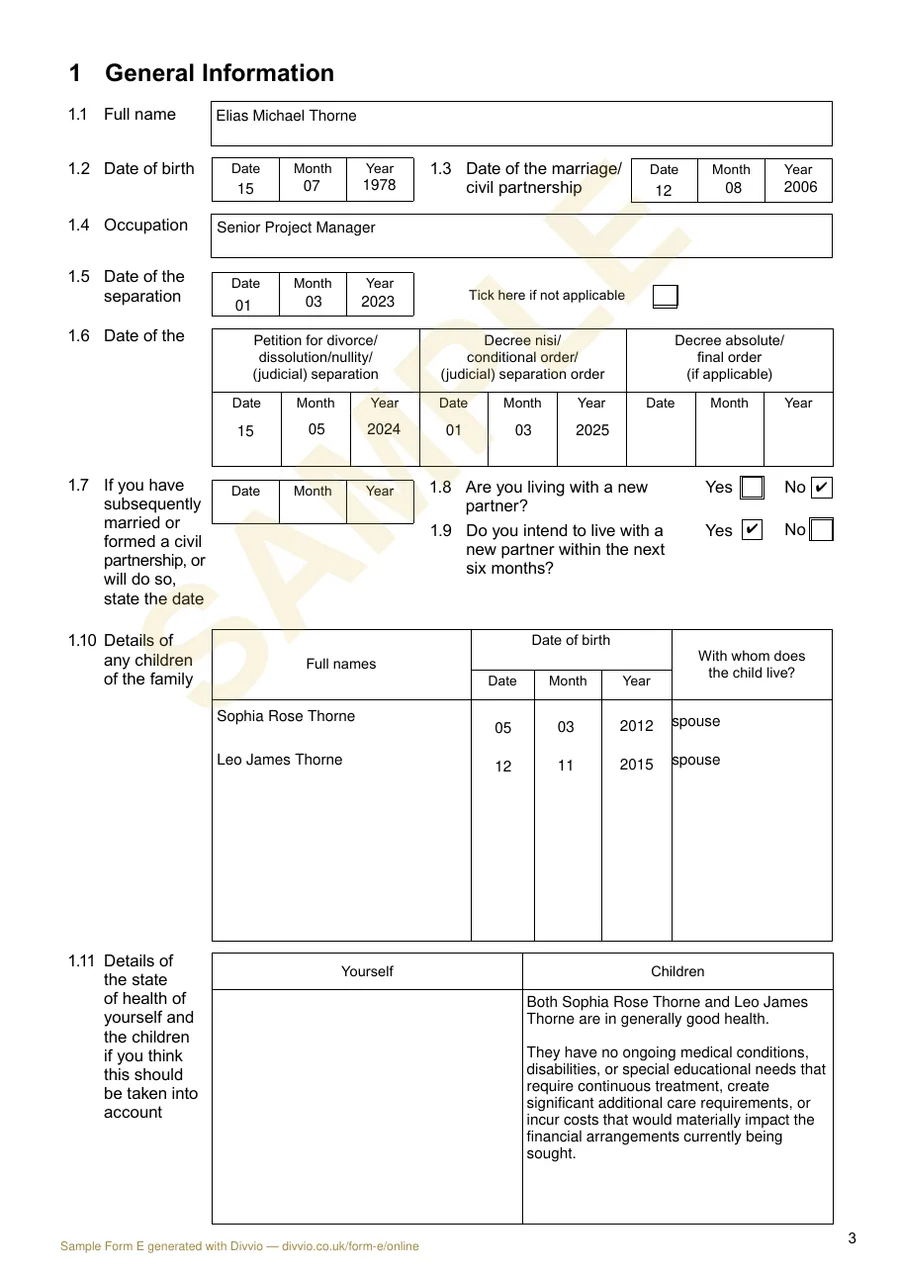 See the full sample Form E (PDF)
Fill in your Form E online, with guidance at every step
Divvio turns your answers into a completed Form E PDF. Answer straightforward questions about your finances, save your progress, and return whenever you’re ready. Divvio puts your answers into the official court form.
- Start free
- Create an account and work through your answers at your own pace.
- See what you’ll receive
- View a completed sample Form E (PDF).
- Pay when it’s ready
- One payment to download your completed PDF, ready for you to review, sign and exchange. Includes a 14-day money-back guarantee.
Free to start and save. £79 to download.
Autumn offer offer: £79 until 30 November, normally £149.