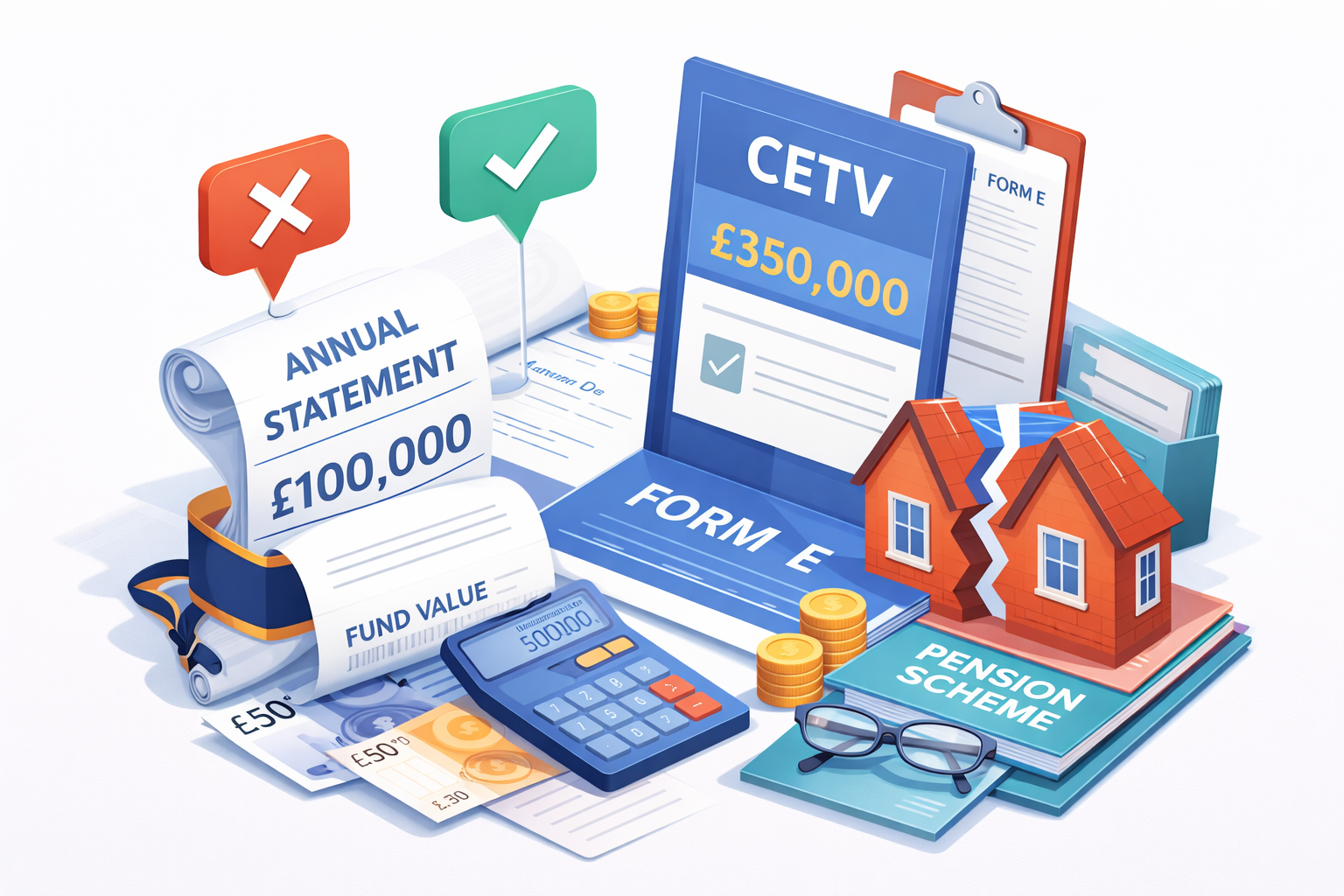
If you are filling in Form E, do not treat a pension annual statement as the final answer. Form E asks for a recent cash equivalent for each pension arrangement, or clear evidence that you have requested it and when it is expected.
Pensions are easy to underestimate in divorce because they do not feel like money you can spend today. In many cases they are still one of the largest assets in the marriage, and sometimes worth more than the family home. The practical job is not to guess what the pension "feels" worth. It is to disclose the right evidence, in the right section, early enough that it does not hold up the timetable.
This guide is for financial remedy cases in England and Wales. It is general information, not legal, financial or pension advice.
What Form E Actually Asks For
Pensions go in section 2.13 of Form E: "Pensions and Pension Protection Fund (PPF) Compensation". You need to give details of all pension rights and PPF compensation entitlements, including prospective entitlements.
For each pension, Form E asks for details such as:
- the name and address of the pension arrangement or PPF Board;
- your National Insurance number;
- the pension reference number;
- the type of scheme, for example occupational, personal, final salary, money purchase, additional state pension, PPF or other;
- the date the cash equivalent, PPF compensation valuation or additional state pension valuation was calculated;
- whether the pension is already in payment or drawdown;
- the cash equivalent quotation, additional state pension valuation or PPF valuation.
The official form calls this a CE, short for cash equivalent. In everyday divorce discussions people often say CETV, meaning Cash Equivalent Transfer Value. For most practical purposes, the task is the same: ask the pension provider or scheme administrator for the cash equivalent figure needed for divorce disclosure.
CETV vs Fund Value: The Common Mistake
An annual pension statement might show a fund value, projected retirement income, transfer value, benefits statement or online dashboard figure. Those are not all the same thing.
| What you are looking at | Why it may not be enough for Form E |
|---|---|
| Annual statement | It may be out of date, projected, or not calculated on the basis Form E needs. |
| Online pension pot value | It may show the current fund value but not charges, guarantees, reductions or scheme-specific transfer rules. |
| Defined benefit annual pension | An income promise such as GBP 12,000 a year is not a capital value. You usually need a cash equivalent to compare it with other assets. |
| Cash equivalent / CETV | This is the figure Form E is usually driving you toward, supported by a recent statement from the scheme. |
For a defined contribution pension, the cash equivalent may be close to the fund value, but you should still request the proper figure. For a defined benefit or final salary pension, the difference can be substantial. A pension promising income for life can have a capital value that is not obvious from the annual income figure.
Which Pensions Should You Include?
Form E tells you to include membership of all pension plans or schemes. That means you should think beyond the pension from your current job.
- current workplace pensions;
- old workplace pensions from previous jobs;
- personal pensions and SIPPs;
- defined benefit or final salary schemes;
- public sector pensions such as NHS, Teachers, Civil Service, police, armed forces or local government schemes;
- FSAVC schemes separate from your employer's main scheme;
- PPF compensation entitlements;
- additional state pension rights where relevant.
Form E says to exclude the Basic State Pension. It does not simply exclude everything connected with state pension rights. Section 2.13 specifically refers to Additional State Pension, SERPS and State Second Pension. If you are unsure whether this applies to you, check the official Form E notes or get advice.
How Recent Does the Pension Valuation Need to Be?
The Form E notes say that if you have a pension valuation, you must attach it, but you may only use it if it will not be more than one year old at the date of the first appointment.
That matters because people often find an old statement and assume it will do. If it will be too old by the hearing date, write to the provider or administrator and ask for an up-to-date valuation. Keep a copy of the request and any reply.
How To Request a CETV for Divorce
Do this as soon as Form E is likely to be needed. Pensions are one of the document requests most likely to slow everything else down.
- List every pension you can identify. Check old payslips, old employers, annual statements, emails from providers, government Gateway records and your current workplace benefits portal.
- Contact each provider or scheme administrator. Use the secure portal if there is one, but save a copy of the message or confirmation.
- Ask for the right thing. Do not just ask for "my latest pension statement" unless the provider confirms it contains the cash equivalent needed for divorce disclosure.
- Record the date requested. You may need this if the valuation has not arrived by the Form E deadline.
- Upload or attach the statement when it arrives. Use the valuation date shown on the document, not the date you opened the email.
You can use wording like this:
Please provide a recent cash equivalent / CETV statement for my pension arrangement for divorce financial disclosure and Form E purposes. Please include the valuation date, scheme type, pension reference, whether the pension is in payment or drawdown, and any note about reductions or restrictions affecting the quoted cash equivalent.
If the scheme is a PPF case, ask for the PPF compensation valuation. If the issue is Additional State Pension, follow the relevant DWP route for a valuation and keep proof of the application date.
What If the CETV Has Not Arrived?
Do not invent a figure and hope to fix it later. Form E tells you what to do if a valuation is not available: give the estimated date when it will be available and attach a copy of your letter or request to the pension company, administrator or PPF Board.
A sensible Form E entry usually records:
- the pension provider or scheme name;
- the reference number, if known;
- the type of scheme, if known;
- that the cash equivalent has been requested;
- the request date;
- the provider's expected response date, if they gave one;
- that the valuation will follow once received.
Attach the request and any provider reply. That is much better than leaving the pension blank, especially if the pension is likely to be material.